
HYDRAULIC CYLINDER SELECTION GUIDE
Practical guide
Choosing the right cylinder starts from the application. This guide compares the main cylinder types and lists the information that lets our technical office prepare an accurate quote.
Selection guide
Stroke, bore, pressure: the data you need to choose the right cylinder
Which type of cylinder do you need?
Cylinder types at a glance
| Single acting | One pressure chamber; force in one direction only; the rod is repositioned by an external force. Up to 2.500 mm bore and any length. |
|---|---|
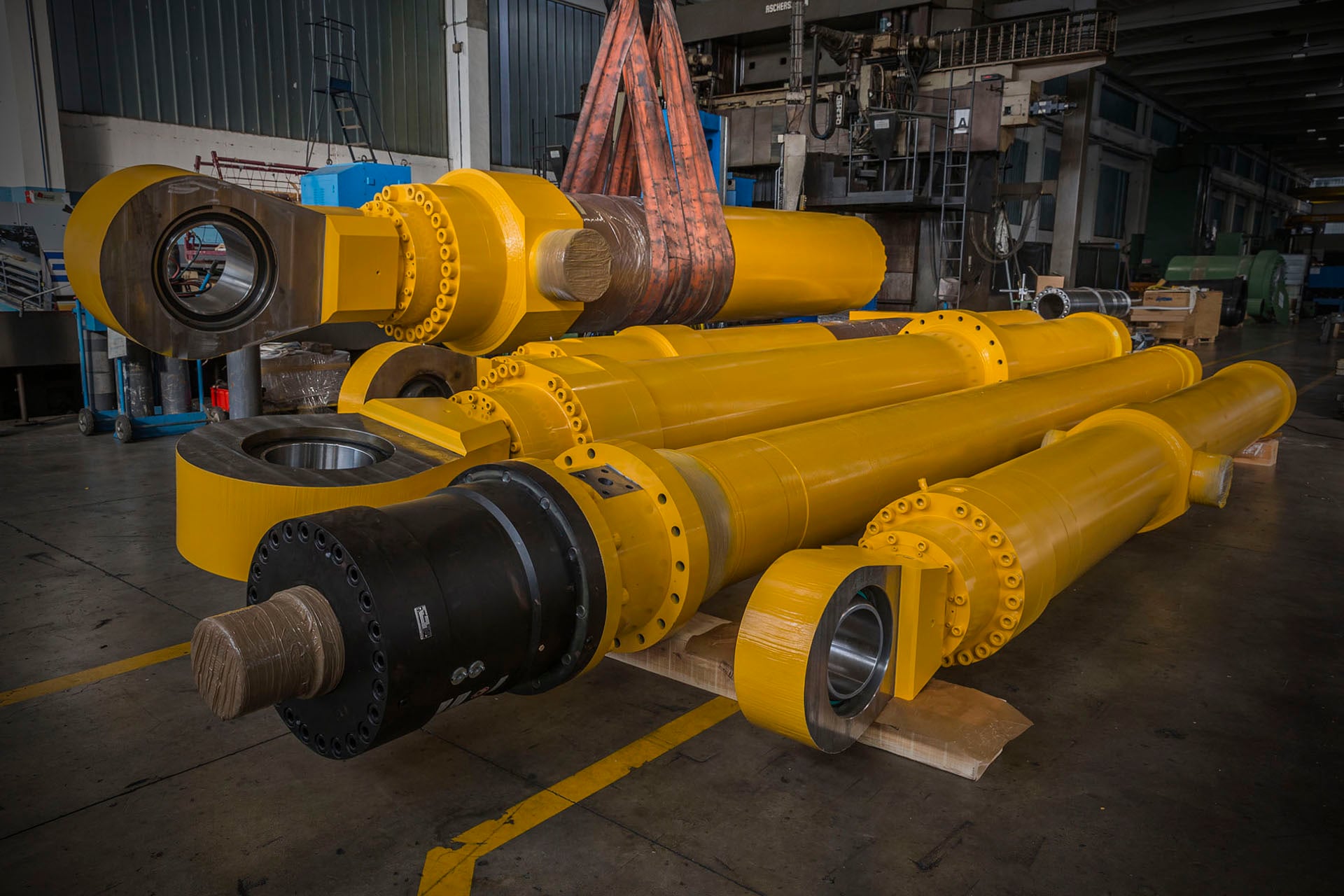
| Double acting | Double pressure chamber, driven by pressure in both directions. Up to 2.500 mm bore and 15.000 mm length. |
| Telescopic (multi-stage) | Very long stroke from a compact retracted length. Hydraulic or pneumatic. |
| Rotary joints and rotary cylinders | Transfer oil, water, grease, emulsion or air from a static part of the machine to a rotating shaft, or the opposite. |
| Rotary actuators | Convert oil pressure into torque and rotation through a rack and pinion. |
| HAGC & AWC capsules | Large diameter, small stroke hydraulic cylinders that develop large forces, used for the rolling load in rolling mills. |
| Standard cylinders | Bore up to 500 mm, stroke up to 11.000 mm, entirely in steel, available in all types of fixing. |
| Piston accumulators | Store and release energy in a hydraulic system through a floating piston and a gas chamber. |
What to send for a quote request
The more complete the data, the faster and more accurate the quote. Please include, where known:
- Cylinder type: single acting, double acting, telescopic, rotating, standard
- Bore and rod diameter, or the force and speed required
- Stroke and the retracted length available for installation
- Operating and maximum pressure
- Mounting type and connections (SAE, CETOP, GAS, NPT and others)
- Fluid (oil, water, emulsion, air) and operating temperature
- Environment: steel mill, offshore, outdoor, dust, corrosive atmosphere
- Duty cycle: speed, frequency of operation, expected life
- Options: position transducers, sensors, rod treatments, cushioning
- Standards, certifications and tests required, such as static and dynamic tests and material certificates
- Drawings or data of the existing cylinder for a replacement or revamping, and the quantity
Send everything to fossaspa@fossacilindri.com or call +39 0331 792597: if some data is missing, our technical office can help you complete it.
Frequently asked questions
Where are Fossa cylinders designed and tested?+
At our works in Gallarate (VA), Italy: design, FEM analysis, machining and testing in dedicated test rigs are carried out in-house at Silvio Fossa S.p.A.
What is the difference between single and double acting cylinders?+
A single acting cylinder has one pressure chamber, so the force is developed in one direction only and the rod is repositioned by an external force. A double acting cylinder has a double pressure chamber and is driven by pressure in both directions.
When is a telescopic cylinder the better choice?+
When the installation space is limited but a long stroke is needed: a telescopic cylinder reaches a very long stroke from a compact retracted length.
Can Silvio Fossa S.p.A. replace or revamp a cylinder made by another manufacturer?+
Yes. Silvio Fossa S.p.A. offers a complete revamping service for all kinds of cylinders, both its own and those of other manufacturers. Sending the drawings or the data of the existing cylinder speeds up the quote.
What are the largest cylinders Silvio Fossa S.p.A. can build?+
Silvio Fossa S.p.A. works components with dimensions up to 3.000 mm diameter and 15.000 mm length and can assemble cylinders and components weighing up to 100 tons.
Need a cylinder built around your application?
Tell us your requirements and our technical office will prepare a quote.